Jianliang Xu, Ph.D.
-
Assistant Professor, HIV Cure and Viral Diseases Center
Xu earned his B.S. in Bioengineering from Nanjing Agriculture University, and M.A. and Ph.D. degrees in Biochemistry and Molecular Biology from Nanjing University in China. He did his postdoctoral training in the laboratory of Tasuku Honjo at Kyoto University, working on antibody maturation and diversification. He extended this work in the laboratory of Rafael Casellas at the NIH studying transcription factor dynamics in primary B cells, engineering nanobody-producing mouse model (nanomouse, JAX 036538) and developing broadly neutralizing nanobodies against SARS-CoV-2. He then worked in Peter Kwong’s lab at the Vaccine Research Center/NIH as a research fellow on anti-HIV-1 nanobody development and structure-based antibody improvement. Xu became an assistant professor at Georgia State University in June 2023 and joined The Wistar Institute as an assistant professor in January 2026.
The Xu Laboratory
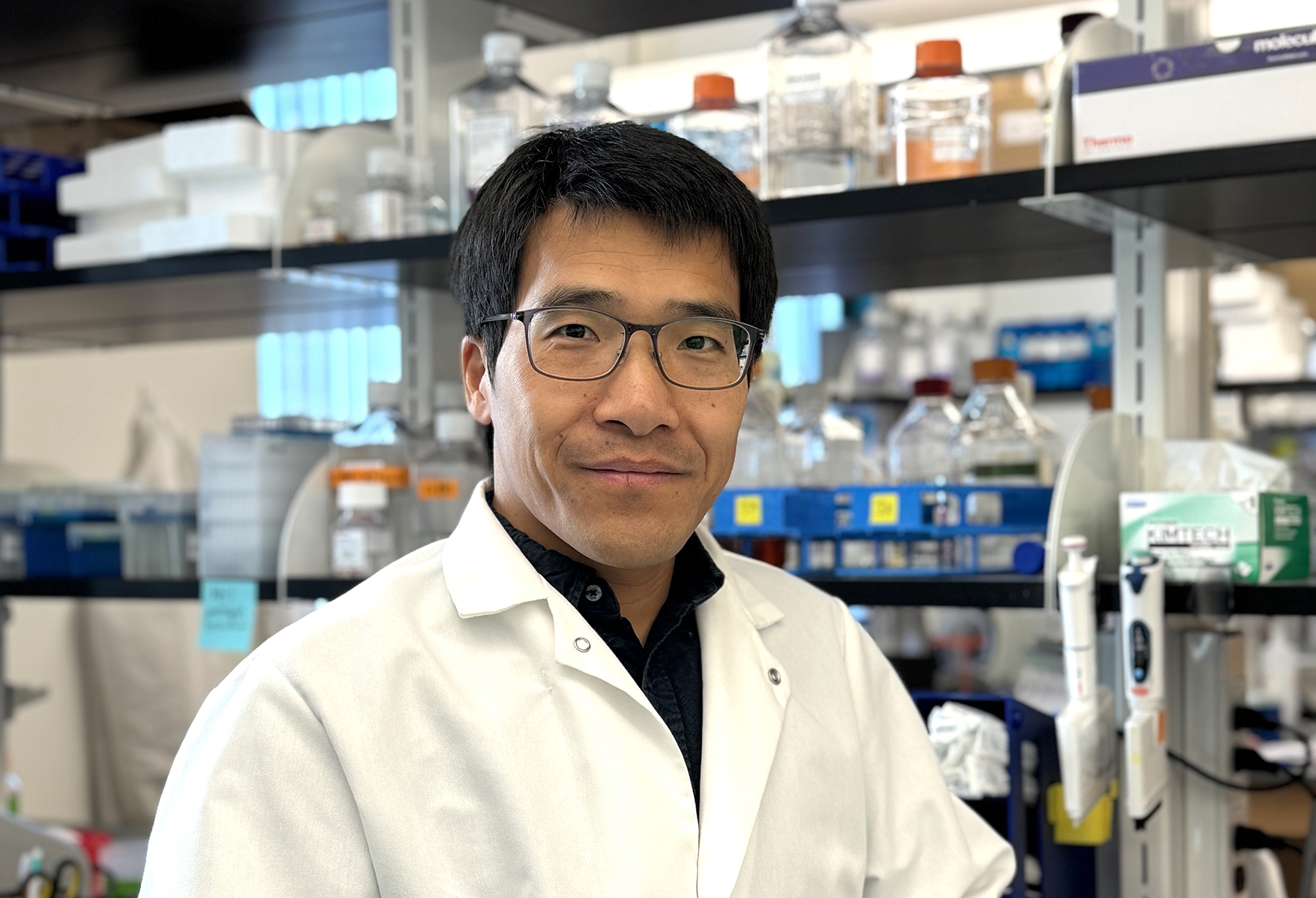
The Xu Laboratory
The COVID-19 pandemic highlights the urgent need for rapidly deployable novel drug development technologies that are prepositioned to respond rapidly when emergent pathogens arise. Our expertise in antibody and nanobody technologies can contribute to this important goal.
Nanobodies are antigen-binding entities derived from the heavy chain-only antibodies of camelid animals, and they retain full antigen specificity at a very small size (~13 kDa). They can penetrate tissues and recognize epitopes that are often inaccessible to conventional antibodies.
Such “hidden” epitopes also have the potential to be conserved across viral strains, making nanobodies ideal antiviral drugs with great cross-reactivity to multiple viral pathogens. Our long-term goal is to establish efficient nanobody development platforms and use these platforms to produce novel biological molecules across multiple therapeutic areas, including infectious diseases and immuno-oncology.
-
Learn about job opportunities at The Wistar Institute here.
Research
Our research builds upon three nanobody development platforms: conventional camelid animals, a novel nanomouse model (JAX 036538), and human nanobody libraries with low immunogenicity. For infectious diseases, we are currently focusing on developing broad and potent neutralizing nanobodies against HIV-1, Henipaviruses (HNV), Arenaviruses (ARV), Human metapneumovirus (HMPV), Respiratory syncytial virus (RSV), and Hantavirus (HTNV). For immuno-oncology, we are developing nanobodies against immune checkpoint receptors as well as glioblastoma (GBM), the most prevalent and aggressive primary brain tumor with fatal outcome due to a lack of effective treatment. To bridge the research between GBM and infections (such as HNV) that cause central nervous system (CNS) illnesses, we are also developing nanobodies to facilitate drug delivery across the blood-brain barrier (BBB).
These studies have the potential to result in lifesaving therapeutics and will broaden our understanding of the mechanisms of viral infections, carcinogenesis, and inform how to efficiently prevent them via vaccine development. Our research will be broadly beneficial to multiple fields, including immunology and translational medicine, infectious disease research, vaccine research, and cancer research, which aligns with our societal goal to enhance health, lengthen life, and reduce illness and disability.
Xu Lab in the News
Selected Publications
Ultrapotent Broadly Neutralizing Human-llama Bispecific Antibodies against HIV-1
Jianliang Xu, Tongqing Zhou, Krisha McKee, Baoshan Zhang, Cuiping Liu , Alexandra F Nazzari, Amarendra Pegu, Chen-Hsiang Shen, Jordan E Becker, Michael F Bender, Payton Chan, Anita Changela, Ridhi Chaudhary, Xuejun Chen, Tal Einav, Young Do Kwon, Bob C Lin, Mark K Louder, Jonah S Merriam, Nicholas C Morano, Sijy O’Dell, Adam S Olia, Reda Rawi, Ryan S Roark, Tyler Stephens, I-Ting Teng, Emily Tourtellott-Fogt, Shuishu Wang 1, Eun Sung Yang, Lawrence Shapiro, Yaroslav Tsybovsky, Nicole A Doria-Rose, Rafael Casellas, Peter D Kwong. Ultrapotent Broadly Neutralizing Human-llama Bispecific Antibodies against HIV-1 PMID: 38704686 PMCID: PMC11234422 DOI: 10.1002/advs.202309268
Nanobodies from camelid mice and llamas neutralize SARS-CoV-2 variants
Jianliang Xu, Kai Xu, Seolkyoung Jung, Andrea Conte, Jenna Lieberman, Frauke Muecksch, Julio Cesar Cetrulo Lorenzi, Solji Park, Fabian Schmidt, Zijun Wang, Yaoxing Huang, Yang Luo, Manoj S Nair, Pengfei Wang, Jonathan E Schulz, Lino Tessarollo, Tatsiana Bylund, Gwo-Yu Chuang, Adam S Olia, Tyler Stephens, I-Ting Teng, Yaroslav Tsybovsky, Tongqing Zhou, Vincent Munster, David D Ho, Theodora Hatziioannou, Paul D Bieniasz, Michel C Nussenzweig, Peter D Kwong, Rafael Casellas. Nanobodies from camelid mice and llamas neutralize SARS-CoV-2 variants. PMID: 34098567 PMCID: PMC8260353 DOI: 10.1038/s41586-021-03676-z
mRNA vaccine-elicited antibodies to SARS-CoV-2 and circulating variants
Zijun Wang, Fabian Schmidt, Yiska Weisblum, Frauke Muecksch, Christopher O Barnes, Shlomo Finkin, Dennis Schaefer-Babajew, Melissa Cipolla, Christian Gaebler, Jenna A Lieberman, Thiago Y Oliveira, Zhi Yang, Morgan E Abernathy, Kathryn E Huey-Tubman, Arlene Hurley, Martina Turroja, Kamille A West, Kristie Gordon, Katrina G Millard, Victor Ramos, Justin Da Silva, Jianliang Xu, Robert A Colbert, Roshni Patel, Juan Dizon, Cecille Unson-O’Brien, Irina Shimeliovich, Anna Gazumyan, Marina Caskey, Pamela J Bjorkman, Rafael Casellas, Theodora Hatziioannou, Paul D Bieniasz, Michel C Nussenzweig. mRNA vaccine-elicited antibodies to SARS-CoV-2 and circulating variants. PMID: 33567448 PMCID: PMC8503938 DOI: 10.1038/s41586-021-03324-6
SAMHD1-mediated dNTP degradation is required for efficient DNA repair during antibody class switch recombination
Afzal Husain, Jianliang Xu, Hodaka Fujii, Mikiyo Nakata, Maki Kobayashi Ji-Yang Wang, Jan Rehwinkel, Tasuku Honjo, Nasim A Begum. SAMHD1-mediated dNTP degradation is required for efficient DNA repair during antibody class switch recombination. PMID: 32511795 PMCID: PMC7396875 DOI: 10.15252/embj.2019102931
Myc Regulates Chromatin Decompaction and Nuclear Architecture during B Cell Activation
Kyong-Rim Kieffer-Kwon, Keisuke Nimura, Suhas S P Rao, Jianliang Xu, Seolkyoung Jung, Aleksandra Pekowska, Marei Dose, Evan Stevens, Ewy Mathe, Peng Dong, Su-Chen Huang, Maria Aurelia Ricci, Laura Baranello, Ying Zheng, Francesco Tomassoni Ardori, Wolfgang Resch, Diana Stavreva, Steevenson Nelson, Michael McAndrew, Adriel Casellas, Elizabeth Finn, Charles Gregory, Brian Glenn St Hilaire, Steven M Johnson, Wendy Dubois, Maria Pia Cosma, Eric Batchelor, David Levens, Robert D Phair, Tom Misteli, Lino Tessarollo, Gordon Hager, Melike Lakadamyali, Zhe Liu, Monique Floer, Hari Shroff, Erez Lieberman Aiden, Rafael Casellas. Myc Regulates Chromatin Decompaction and Nuclear Architecture during B Cell Activation. PMID: 28803781 PMCID: PMC5854204 DOI: 10.1016/j.molcel.2017.07.013