Dr. McGinnis is a cancer immunologist studying cellular and molecular mechanisms of tumor-microenvironment interactions during metastasis. Dr. McGinnis’ approach is fundamentally interdisciplinary, functioning at the interface of cancer immunology, metastasis biology, and genomics. His long-term goal is to improve our understanding of how tumors co-opt distant organ sites during metastasis and translate these basic biological insights into anti-metastatic therapies.
Dr. McGinnis completed his B.A. in Molecular Biology & Biochemistry at Wesleyan University in 2014. In 2016, he joined Dr. Zev Gartner’s lab at UC San Francisco as a Ph.D. student, where he developed computational and molecular tools for single-cell genomics analysis including MULTI-seq and DoubletFinder. In 2021, Dr. McGinnis started a postdoctoral fellowship at Stanford University in the lab of Dr. Ansu Satpathy, where he profiled the temporal patterns of lung metastatic niche co-option in breast cancer and developed a single-cell chemical transcriptomics platform for interrogating microenvironmental responses to drug perturbations in the lung metastatic niche. Dr. McGinnis’ research has been recognized with honors including the NCI K99/R00 Pathway to Independence Award and the METAVivor Early Career Investigator Award.
The McGinnis Laboratory

The McGinnis Laboratory
Decades of cancer biology have led to the discovery of ‘cancer genes’ (e.g., oncogenes and tumor suppressors) and, in turn, rationally-designed chemotherapies. In contrast, efforts to find ‘metastasis genes’ have largely failed, leading to a complete lack of clinically-approved therapies for limiting metastatic progression. This failure calls for new conceptual and experimental approaches to develop anti-metastatic therapies by focusing on the metastatic microenvironment.
Diverse interactions between primary tumor ‘seeds’ and immune/stromal cells in the microenvironmental ‘soil’ are necessary for metastatic progression and could be targeted by anti-metastatic therapies. However, two barriers exist that make achieving this goal a challenge. First, how pro-metastatic niche remodeling mechanisms manifest over time and differ between tumor types and metastatic sites remains poorly understood. Second, traditional drug screening platforms are ill-suited to discover anti-metastatic therapies because they leverage cell systems and read-outs that fail to model perturbation responses in the metastatic niche.
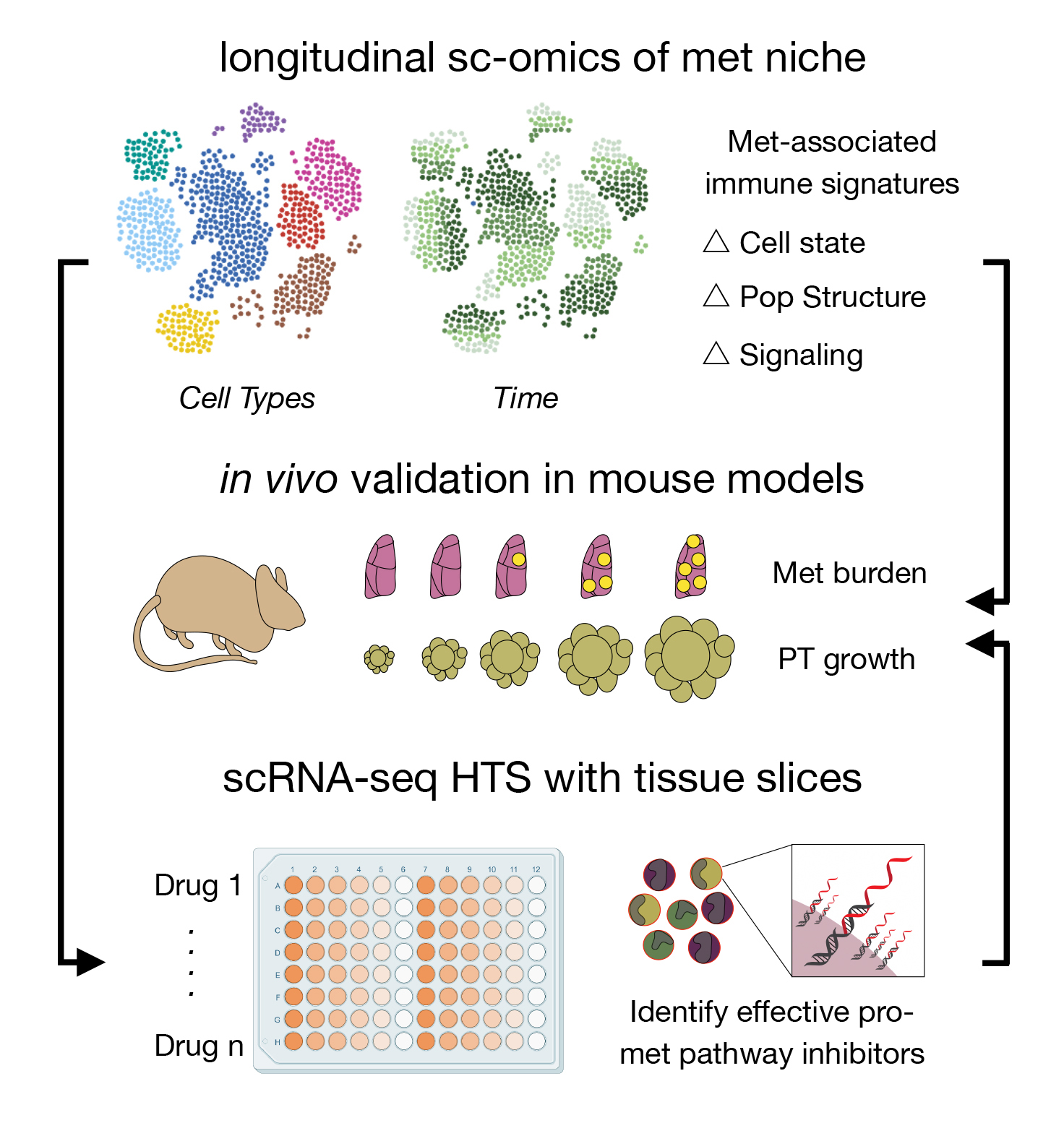
The McGinnis Lab works to address these two barriers by using longitudinal and perturbational single-cell genomics to discover how the metastatic niche is co-opted during disease progression and target pro-metastatic immune/stromal remodeling mechanisms to develop anti-metastatic therapies.
Research
FOCUS 1: Organism-level profiling of metastatic ‘archetypes’
We previously performed a longitudinal single-cell genomics analysis of the lung immune microenvironment before, during, and after breast cancer metastasis, revealing previously unreported immunological changes such as elevated myeloid TLR-NFkB inflammation in the pre-metastatic niche, increased NK cytotoxicity in metastasis-bearing lungs, and cell-type-specific differential regulation of CCL6 signaling. However, learning the design principles of pro-metastatic niche co-option will require zooming out from this single tissue (lung), cell lineage (immune), and disease context (aggressive breast cancer). Thus, we build organism-level temporal maps of metastatic progression (primary tumor, metastatic site, peripheral immune system, and lymphoid organs) spanning diverse tumor models (aggressive and dormant) and metastatic sites (lung, liver, bone, and brain) using multiplexed single-cell genomics with tumor/immune lineage-tracing approaches. We are interested in the following questions:
(1) What changes in the immune/stromal niche precede the formation of (dormant) micrometastases and macrometastatic outgrowth?
(2) How do metastasis-associated niche remodeling signatures compare between different metastatic sites and tumor models?
(3) Across primary tumors with overlapping tissue tropism (e.g., lung tropism for breast cancer, osteosarcoma, and melanoma), are different ‘trajectories’ of niche remodeling associated with metastatic progression? Or is pro-metastatic remodeling agnostic of primary tumor source?

FOCUS 2: Single-cell chemical transcriptomics
Traditional high-throughput screening (HTS) platforms use simple read-outs (e.g., cell proliferation) and contrived in vitro systems (e.g., tumor cell lines) that fail to adequately capture how complex biological systems respond to chemical perturbation. To address this limitation, we couple our MULTI-seq sample multiplexing technology with ex vivo tissue slice culture systems to perform single-cell genomics-coupled HTS experiments, focusing on the lung metastatic niche. By measuring transcriptome-wide single-cell perturbation responses in systems that preserve the cellular composition of the in vivo lung niche, we aim to address the following questions:
(1) What chemical compounds optimally target metastasis-associated immune and stromal signaling pathways without inducing undesirable off-target effects?
(2) How do standard-of-care chemotherapy regimens influence the metastatic niche and potentially promote disease progression?
(3) Can we use machine learning approaches to leverage our database of genomic drug ‘fingerprints’ to predict the effects of untested drugs and drug combinations in the metastatic microenvironment?
