Wistar Scientists Develop Single-Dose DNA Method for Delivering Long-acting Weight Loss and Diabetes Drugs

PRESS RELEASE

PHILADELPHIA — (June 26, 2026) — Scientists at The Wistar Institute have shown that a single injection of a small, circular piece of genetic instructions can produce weight loss and blood glucose control in murine models that lasts up to 10 times as long as incretin-mimicking drugs like Ozempic and Wegovy. If shown to be successful in clinical trials, this new method of delivery could eliminate the need for repeated dosing, which currently limits patient access and adherence to these therapies.

Incretin hormones like GLP-1 and GIP, which are naturally produced in the body, regulate blood sugar and appetite. Drugs that mimic them have proven to be extremely effective for treating type 2 diabetes and obesity. However, their native forms break down quickly in the body, so current therapies require weekly injections or daily pills—regimens that demand sustained patient compliance and contribute to the rebound in weight gain and blood glucose dysregulation when patients stop treatment.

“What we’re trying to do here is simple: We want to deliver a drug once and have it work for a really long time,” said Ebony Gary, Ph.D., a research assistant professor in the laboratory of David B. Weiner at The Wistar Institute’s Vaccine and Immunotherapy Center and first author of the study.

“The DNA platform has demonstrated it can do that. Instead of delivering a drug that will get cleared by the body, we’re giving cells the instructions to make that drug themselves, and they keep making it.”

Her team’s approach builds on Weiner Lab research already validated in human patients that showed the human body can function as a “factory” to produce long-lasting antibodies. The lab developed an intramuscular DNA electroporation platform, whereby patients receive a shot of plasmid DNA (the genetic instructions) followed by an electrical pulse to help get the instructions into the nucleus of the body’s cells where they can be read. Weiner and his colleagues used this method to deliver “instructions” for COVID-19-neutralizing antibodies to patients. In a Phase 1 clinical trial, two of the antibodies were expressed continuously in human subjects for more than 72 weeks.

To adapt this platform for metabolic disease, Gary and her colleagues engineered DNA instructions for long-acting incretin hormones GLP-1 and GIP, which they call pLincretins. Importantly, they included an antibody fragment in the instructions that would help prevent the protein from breaking down quickly in the body the way current incretin-mimicking drugs do. When tested in preclinical murine models of diabetes using the electroporation method, a single dose of pLincretins produced detectable levels of incretins for up to 70 days and drove sustained reductions in body weight and blood glucose. In a head-to-head comparison with semaglutide (the active ingredient in Ozempic), murine models treated with a single dose of the scientists’ DNA construct maintained these metabolic improvements even after the observation period ended, while those treated with semaglutide began regaining weight as soon as dosing stopped.

The scientists then used AI-assisted structural modeling, and an approach called synthetic consensus design to create a new molecule called pSynCretin. The team designed it by identifying the structural elements common across GLP-1, GIP, and existing incretin drugs and then combining those elements into a single protein that could engage the GLP-1 and GIP receptors simultaneously (similar to how Mounjaro works). A single dose of pSynCretin also induced sustained weight loss in murine models.

Gary and others in the Weiner Lab are now pursuing studies on the immunological effects of incretin therapy, including its potential role in modifying cancer outcomes. Clinical data have shown that patients on incretin drugs experience improvements in chronic inflammatory conditions like arthritis and psoriasis. This opens up new questions about the relationship between metabolism and immune function that Gary believes the DNA platform can help to answer.

“What I keep coming back to is how much we still don’t know about what these molecules are doing beyond weight loss and blood glucose,” Gary said. “There’s lots of data from patients on incretin therapy in the clinic now and just being on these drugs that we think of as weight loss drugs or diabetes drugs has also affected people’s chronic inflammatory diseases like arthritis and psoriasis. It’s made me start thinking about the immunological implications of incretin therapy.”

Gary also sees potential for the DNA delivery platform to extend well beyond metabolic disease. The same delivery system that enables long-term incretin production in the body could potentially be applied to a wide range of therapeutic proteins needed to treat chronic conditions.

“The really amazing part of this research is that once we have this toolkit, we can think about making novel proteins that didn’t exist before and engineering them from the ground up to do exactly what we need them to do,” Gary said. “The possibilities are really exciting.”

Co-authors: Yangcheng Gao, Casey E. Hojecki, Nicholas J. Tursi, Wujuan Zhang, Aaron R. Goldman, Niklas Laenger, Martina Tomirotti, Mohammad Suhail Khan, Riya Sahai, Jacob Oblander, Jinwei Huang, Zi Jie Lin, Jiayan Cui, Xiaoyang Liu, Jesper Pallesen, Elizabeth M. Parzych, and David B. Weiner from The Wistar Institute; Laurent Humeau from Inovio Pharmaceuticals.

Work supported by: the W.W. Smith Charitable Trust Distinguished Professorship in Cancer Research to D.B.W.; The Jill and Mark Fishman Foundation to D.B.W.; National Cancer Institute grant T32 CA009171 to N.J.T.; a Pathway to Independence Award from The Wistar Institute to E.N.G.; and funding from Inovio Pharmaceuticals.

Publication information: Engineering Single-dose Plasmid DNA for Sustained in Vivo Delivery of Designer Incretins, Trends in Biotechnology, 2026. Online publication.

For a printer-friendly version of this release, please click here.

ABOUT THE WISTAR INSTITUTE:

The Wistar Institute is the nation’s first independent nonprofit institution devoted exclusively to foundational biomedical research and training. Since 1972, the Institute has held National Cancer Institute (NCI)-designated Cancer Center status. Through a culture and commitment to biomedical collaboration and innovation, Wistar science leads to breakthrough early-stage discoveries and life science sector start-ups. Wistar scientists are dedicated to solving some of the world’s most challenging problems in the field of cancer and immunology, advancing human health through early-stage discovery and training the next generation of biomedical researchers. wistar.org



Continue reading

Christopher McGinnis, Ph.D.

  • Assistant Professor, Vaccine & Immunotherapy Center

  • Molecular and Cellular Oncogenesis Program, Ellen and Ronald Caplan Cancer Center

Dr. McGinnis is a cancer immunologist studying cellular and molecular mechanisms of tumor-microenvironment interactions during metastasis. Dr. McGinnis’ approach is fundamentally interdisciplinary, functioning at the interface of cancer immunology, metastasis biology, and genomics. His long-term goal is to improve our understanding of how tumors co-opt distant organ sites during metastasis and translate these basic biological insights into anti-metastatic therapies.

Dr. McGinnis completed his B.A. in Molecular Biology & Biochemistry at Wesleyan University in 2014. In 2016, he joined Dr. Zev Gartner’s lab at UC San Francisco as a Ph.D. student, where he developed computational and molecular tools for single-cell genomics analysis including MULTI-seq and DoubletFinder. In 2021, Dr. McGinnis started a postdoctoral fellowship at Stanford University in the lab of Dr. Ansu Satpathy, where he profiled the temporal patterns of lung metastatic niche co-option in breast cancer and developed a single-cell chemical transcriptomics platform for interrogating microenvironmental responses to drug perturbations in the lung metastatic niche. Dr. McGinnis’ research has been recognized with honors including the NCI K99/R00 Pathway to Independence Award and the METAVivor Early Career Investigator Award.

View Publications

The McGinnis Laboratory

Available Positions

Learn about job opportunities at The Wistar Institute here.

The McGinnis Laboratory

Decades of cancer biology have led to the discovery of ‘cancer genes’ (e.g., oncogenes and tumor suppressors) and, in turn, rationally-designed chemotherapies. In contrast, efforts to find ‘metastasis genes’ have largely failed, leading to a complete lack of clinically-approved therapies for limiting metastatic progression. This failure calls for new conceptual and experimental approaches to develop anti-metastatic therapies by focusing on the metastatic microenvironment.

Diverse interactions between primary tumor ‘seeds’ and immune/stromal cells in the microenvironmental ‘soil’ are necessary for metastatic progression and could be targeted by anti-metastatic therapies. However, two barriers exist that make achieving this goal a challenge. First, how pro-metastatic niche remodeling mechanisms manifest over time and differ between tumor types and metastatic sites remains poorly understood. Second, traditional drug screening platforms are ill-suited to discover anti-metastatic therapies because they leverage cell systems and read-outs that fail to model perturbation responses in the metastatic niche.

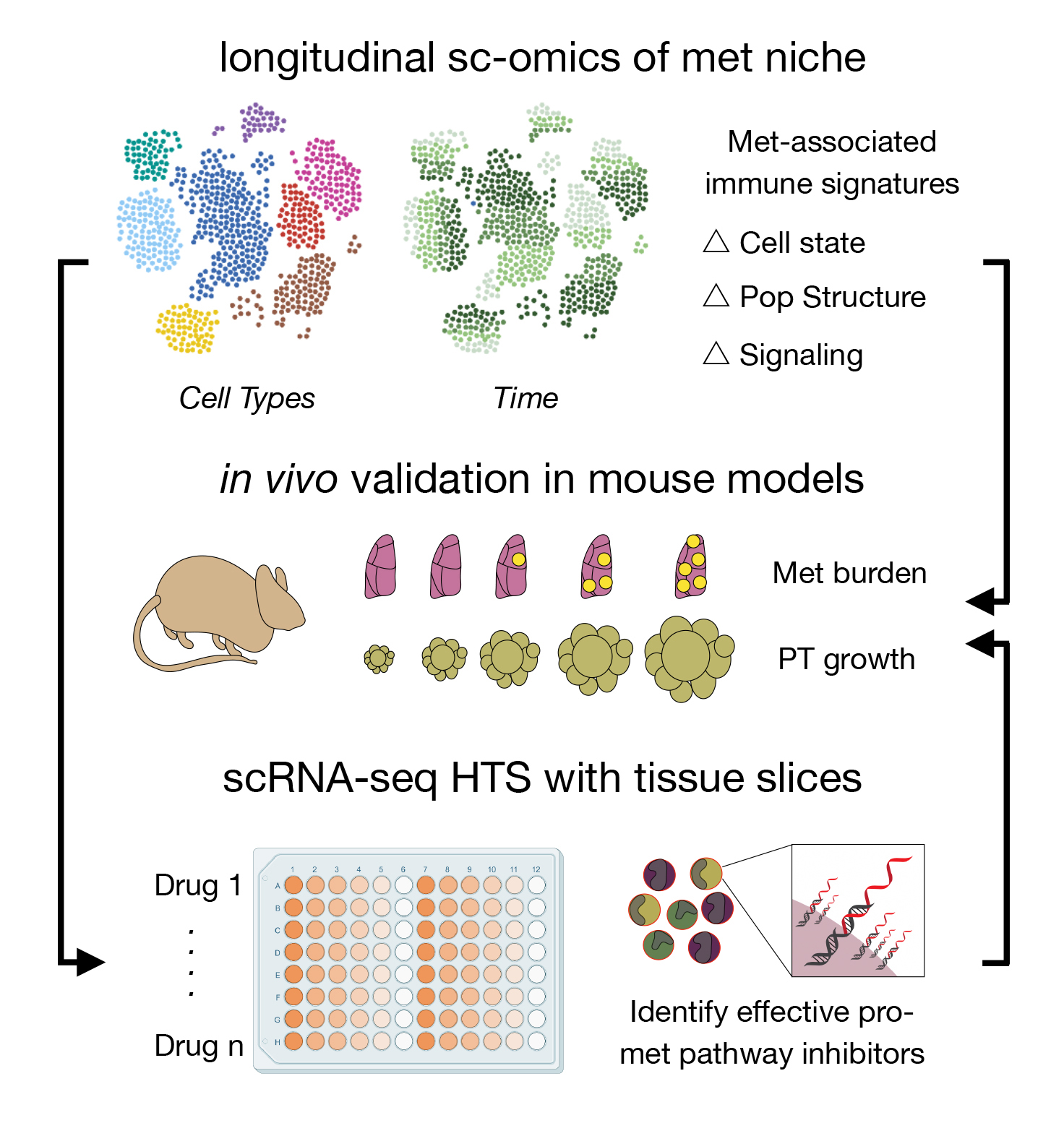
The McGinnis Lab works to address these two barriers by using longitudinal and perturbational single-cell genomics to discover how the metastatic niche is co-opted during disease progression and target pro-metastatic immune/stromal remodeling mechanisms to develop anti-metastatic therapies.

Research

FOCUS 1: Organism-level profiling of metastatic ‘archetypes’

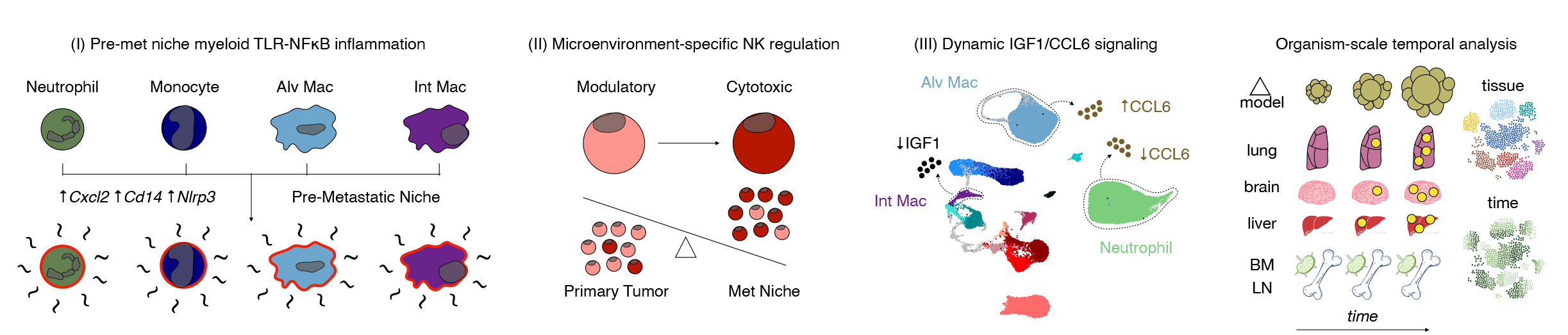
We previously performed a longitudinal single-cell genomics analysis of the lung immune microenvironment before, during, and after breast cancer metastasis, revealing previously unreported immunological changes such as elevated myeloid TLR-NFkB inflammation in the pre-metastatic niche, increased NK cytotoxicity in metastasis-bearing lungs, and cell-type-specific differential regulation of CCL6 signaling. However, learning the design principles of pro-metastatic niche co-option will require zooming out from this single tissue (lung), cell lineage (immune), and disease context (aggressive breast cancer). Thus, we build organism-level temporal maps of metastatic progression (primary tumor, metastatic site, peripheral immune system, and lymphoid organs) spanning diverse tumor models (aggressive and dormant) and metastatic sites (lung, liver, bone, and brain) using multiplexed single-cell genomics with tumor/immune lineage-tracing approaches. We are interested in the following questions:

(1) What changes in the immune/stromal niche precede the formation of (dormant) micrometastases and macrometastatic outgrowth?
(2) How do metastasis-associated niche remodeling signatures compare between different metastatic sites and tumor models?
(3) Across primary tumors with overlapping tissue tropism (e.g., lung tropism for breast cancer, osteosarcoma, and melanoma), are different ‘trajectories’ of niche remodeling associated with metastatic progression? Or is pro-metastatic remodeling agnostic of primary tumor source?

FOCUS 2: Single-cell chemical transcriptomics

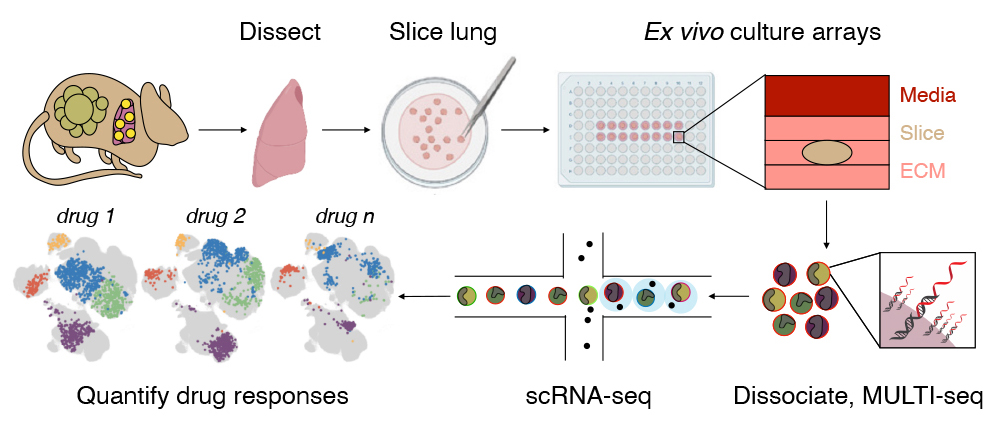
Traditional high-throughput screening (HTS) platforms use simple read-outs (e.g., cell proliferation) and contrived in vitro systems (e.g., tumor cell lines) that fail to adequately capture how complex biological systems respond to chemical perturbation. To address this limitation, we couple our MULTI-seq sample multiplexing technology with ex vivo tissue slice culture systems to perform single-cell genomics-coupled HTS experiments, focusing on the lung metastatic niche. By measuring transcriptome-wide single-cell perturbation responses in systems that preserve the cellular composition of the in vivo lung niche, we aim to address the following questions:

(1) What chemical compounds optimally target metastasis-associated immune and stromal signaling pathways without inducing undesirable off-target effects?
(2) How do standard-of-care chemotherapy regimens influence the metastatic niche and potentially promote disease progression?
(3) Can we use machine learning approaches to leverage our database of genomic drug ‘fingerprints’ to predict the effects of untested drugs and drug combinations in the metastatic microenvironment?

Selected Publications

  • MULTI-seq: sample multiplexing for single-cell RNA sequencing using lipid-tagged indices


    McGinnis CS*, Patterson DM*, Winkler J, Conrad DN, Hein MY, Srivastava V, Hu JL, Murrow LM, Weissman JS, Werb Z, Chow ED, and Gartner ZJ. MULTI-seq: sample multiplexing for single-cell RNA sequencing using lipid-tagged indices. Nature Methods. 2019 Jul;16(7):619-626. doi: 10.1038/s41592-019-0433-8.

  • The temporal progression of lung immune remodeling during breast cancer metastasis

    McGinnis CS, Miao Z, Superville D, Yao W, Goga A, Reticker-Flynn NE, Winkler J, and Satpathy AT. The temporal progression of lung immune remodeling during breast cancer metastasis. Cancer Cell. 2024 Jun 10;42(6):1018-1031.e6. doi: 10.1016/j.ccell.2024.05.004.

  • D-SPIN constructs regulatory network models from scRNA-seq that reveal organizing principles of perturbation response

    Jiang J*, Chen S*, Tsou T, McGinnis CS, Khazaei T, Zhu Q, Park JH, Strazhnik IM, Vielmetter J, Gong Y, Hanna J, Chow ED, Sivak DA, Gartner ZJ, and Thomson M. D-SPIN constructs regulatory network models from scRNA-seq that reveal organizing principles of perturbation response. Cell. 2026 May 12:S0092-8674(26)00463-0. doi: 10.1016/j.cell.2026.04.028.

  • DoubletFinder: Doublet Detection in Single-Cell RNA Sequencing Data Using Artificial Nearest Neighbors

    McGinnis CS, Murrow LM, and Gartner ZJ. DoubletFinder: Doublet Detection in Single-Cell RNA Sequencing Data Using Artificial Nearest Neighbors. Cell Systems. 2019 Apr 24;8(4):329-337.e4. doi: 10.1016/j.cels.2019.03.003

  • Translation dysregulation in cancer as a source for targetable antigens

    Weller C*, Bartok O*, McGinnis CS*, Palashati H, Chang TG, Malko D, Shmueli MD, Nagao A, Hayoun D, Murayama A, Sakaguchi Y, Poulis P, Khatib A, Erlanger Avigdor B, Gordon S, Cohen Shvefel S, Zemanek MJ, Nielsen MM, Boura-Halfon S, Sagie S, Gumpert N, Yang W, Alexeev D, Kyriakidou P, Yao W, Zerbib M, Greenberg P, Benedek G, Litchfield K, Petrovich-Kopitman E, Nagler A, Oren R, Ben-Dor S, Levin Y, Pilpel Y, Rodnina M, Cox J, Merbl Y, Satpathy AT, Carmi Y, Erhard F, Suzuki T, Buskirk AR, Olweus J, Ruppin E, Schlosser A, and Samuels Y. Translation dysregulation in cancer as a source for targetable antigens. Cancer Cell. 2025 May 12;43(5):823-840.e18. doi: 10.1016/j.ccell.2025.03.003

  • T cell engagers control solid tumors through clonal replacement and IL2-driven effector differentiation of CD8 T cells

    Obenaus M*, Poupault C*, McGinnis CS*, Prange C, Jiang H, Su LL, Chen X, Miao Z, Muldoon JJ, Yao W, Waghray D, Sun Q, Eyquem J, Hernández-López RA, Satpathy AT, Sage J, Garcia KC. T cell engagers control solid tumors through clonal replacement and IL2-driven effector differentiation of CD8 T cells. BioRxiv (2026). doi: 10.64898/2025.12.04.692214.

View Additional Publications

Continue reading

Torben Schiffner, Ph.D.

Assistant Professor, Vaccine & Immunotherapy Center

Schiffner’s research focuses on developing advanced vaccines that induce broadly neutralizing antibodies against highly diverse pathogens, combining AI/machine-learning-assisted computational protein design with deep analysis of antibody responses in vivo to iteratively optimize next-generation immunogens.

Schiffner earned an undergraduate degree in Molecular Life Sciences from the University of Hamburg, Germany, and a Master’s degree in Molecular Biology and Pathology of Viruses from Imperial College London. He completed a Doctor of Philosophy at the University of Oxford, where he investigated strategies to redirect antibody responses against HIV-1. At The Scripps Research Institute in California, Schiffner completed postdoctoral training in computational immunogen design and germline-targeting HIV vaccine development.

In 2020, Schiffner was awarded the Sofja Kovalevskaja Award by the Alexander von Humboldt Foundation, one of Germany’s most prestigious early-career investigator awards, and was recruited as junior faculty to the Institute for Drug Discovery, Leipzig University Medical School, where he began applying artificial intelligence to vaccine design.

He returned to Scripps Research in 2023 as an institute investigator, where he established his independent research group and secured major awards from ARPA-H and the NIH to advance AI-driven immunogen design against HIV, alphaviruses, and influenza. 

View Publications

The Schiffner Laboratory

tschiffner@wistar.org

The Schiffner Laboratory

Despite decades of effort, traditional vaccine development has not yielded broadly protective vaccines against highly variable pathogens such as HIV-1, influenza viruses, hepatitis C virus, and alphaviruses. The key to protection against such diverse viruses is the induction of broadly neutralizing antibodies (bnAbs), rare antibodies that recognize conserved sites of vulnerability shared across viral strains.

The Schiffner Laboratory designs next-generation vaccine immunogens that selectively engage and mature the rare B cells that give rise to bnAbs, with the goal of producing vaccines that protect against entire families of antigenically diverse viruses.

To accomplish this, the lab integrates emerging deep-learning technologies with traditional physics-based computational design methods. By coupling these computational approaches with high-throughput experimental pipelines, the lab generates the data needed to train new neural networks for predicting protein–protein interactions and improving immunogen design.

Building on strategies the team has helped develop, including germline targeting, epitope-scaffold design, glycan masking, and pre-fusion stabilization, the Schiffner Lab applies these tools to the design of vaccine candidates against HIV-1, alphaviruses, influenza, and other emerging viral threats. The lab works in close collaboration with experts in structural biology, and clinical testing to rapidly translate computationally designed immunogens into validated vaccine candidates.

Research

Project 1: AI/Machine-Learning-Driven Immunogen Design

A central focus of the Schiffner Lab is the development of computational tools that accelerate and improve the design of vaccine immunogens. While modern deep-learning methods have transformed protein design, no current algorithm can reliably predict protein–protein interaction affinities — a key requirement for designing immunogens that selectively engage rare antibody precursors. The lab is generating high-throughput affinity datasets using yeast-display technologies and using these data to train new neural networks, including message-passing neural networks (MPNNs) and fine-tuned protein language models, that combine sequence and structural information. By integrating these emerging methods with established physics-based design platforms such as Rosetta, the lab aims to substantially increase the success rate of computational immunogen design.

Project 2: Germline-Targeting Vaccines Against HIV-1

The Schiffner Lab continues a long-standing program in HIV-1 vaccine development built around germline targeting, the strategy of designing immunogens that selectively activate the unmutated B-cell precursors of broadly neutralizing antibodies. Schiffner led the development of 10E8-GT12 24mer, a germline-targeting epitope-scaffold immunogen that activates precursors of the HIV-1 bnAb 10E8 in preclinical models and engages corresponding precursors in human blood (Schiffner et al., Nat Immunol, 2024; Ray et al., Nat Immunol, 2024). Building on these advances, the lab is developing additional epitope scaffolds and heterologous boosting immunogens needed to shepherd antibody affinity maturation toward broad neutralization. Recent advances in the lab’s computational pipeline have achieved >50% success rates in de novo epitope-scaffold design, enabling the rapid generation of multiple diverse immunogens for the same antibody lineage.

Project 3: Broadly Protective Vaccines Against Alphaviruses

As part of the ARPA-H–funded “Protect against Emergent Alphaviruses through Computation” (PEAC) consortium, a multi-institutional collaboration combining 14 principal investigators from seven institutions, the Schiffner Lab strives to design AI/ML-based vaccines that broadly protect against diverse alphaviruses. Unlike HIV-1 bnAbs, which are highly mutated, broadly neutralizing antibodies against alphaviruses carry relatively few somatic mutations, opening the possibility of priming and boosting bnAbs with a single vaccine formulation. The lab is developing combined prime-boost cocktails and heterologous prime-boost nanoparticle platforms tailored to lightly mutated bnAb lineages.

Project 4: Computational Immunogen Design Against Influenza and Other Emerging Viruses

Through an NIH U01 award, the Schiffner Lab is applying its AI-enabled immunogen design pipeline to influenza A virus, with the goal of developing immunogens that engage broadly neutralizing antibody precursors against conserved epitopes on hemagglutinin. The lab is also extending its work on pre-fusion stabilization, glycan masking, and germline targeting to additional pathogens including hepatitis C virus and emerging coronaviruses.

Selected Publications

  • Vaccination induces broadly neutralizing antibody precursors to HIV gp41

    T Schiffner, I Phung, R Ray, A Irimia, M Tian, O Swanson, J H Lee, C D Lee, E Marina-Zárate, S Y Cho, J Huang, G Ozorowski, P D Skog, A M Serra, K Rantalainen, J D Allen, S Baboo, OL Rodriguez, S Himansu, J Zhou, J Hurtado, C T Flynn, KMcKenney, C Havenar-Daughton, S Saha, K Shields, S Schultze, M L Smith, C Liang, LToy, S Pecetta, Y Lin , J R Willis, F Sesterhenn, D W Kulp , X Hu, C A Cottrell, X Zhou, J Ruiz, X Wang, U Nair, K H Kirsch, H Cheng, J Davis, O Kalyuzhniy, ALiguori, J K Diedrich, JT Ngo, V Lewis, N Phelps, R D Tingle, S Spencer, E Georgeson, Y Adachi, MKubitz, S Eskandarzadeh, M A Elsliger, R R Amara, E Landais, B Briney, D R Burton, D G Carnathan, G Silvestri, C T Watson, J R Yates 3rd, J C Paulson, M Crispin, G Grigoryan, A B Ward, D Sok, F W Alt, I A Wilson, F D Batista, SCrotty, W R Schief. Vaccination induces broadly neutralizing antibody precursors to HIV gp41. Nat Immunol 25:1073–1082 (2024) Nat Immunol 25:1073–1082 (2024). DOI: 10.1126/science.add6502 PMID: 36454825 PMCID: PMC11103259

  • Affinity gaps among B cells in germinal centers drive the selection of MPER precursors

    R Ray, T Schiffner, X Wang, Y Yan, K Rantalainen, C D Lee, S Parikh, R A Reyes, G A Dale, Y Lin, S Pecetta, S Giguere, O Swanson, S Kratochvil, E Melzi, IPhung, L Madungwe, O Kalyuzhniy, J Warner, S R Weldon, R Tingle, E Lamperti, K H Kirsch , N Phelps, E Georgeson, Y Adachi, M Kubitz, U Nair, S Crotty, I A Wilson, W R Schief, F D Batista. Affinity gaps among B cells in germinal centers drive the selection of MPER precursors. Nat Immunol 25:1083–1096 (2024) DOI: 10.1038/s41590-024-01844-7 PMID: 38816616 PMCID: PMC11147770 

  • Structural and immunologic correlates of chemically stabilized HIV-1 envelope glycoproteins

    T Schiffner, J Pallesen, R A Russell, J Dodd, Nde Val, C C LaBranche, D Montefiori, G D Tomaras, X Shen, SL Harris, A E Moghaddam, O Kalyuzhniy, R W Sanders, LE McCoy, J P Moore, A B Ward, Q J Sattentau. Structural and immunologic correlates of chemically stabilized HIV-1 envelope glycoproteins. PLoS Pathog 14:e1006986 (2018). DOI: 10.1371/journal.ppat.1006986 PMID: 29746590 PMCID: PMC5944921 

  • Chemical Cross-Linking Stabilizes Native-Like HIV-1 Envelope Glycoprotein Trimer Antigens

    T Schiffner, N de Val, R A Russell, S W de Taeye, A T de la Peña, G Ozorowski, H J Kim, T Nieusma, F Brod, ACupo, R W Sanders, J P Moore, A B Ward, Q J Sattentau. Chemical Cross-Linking Stabilizes Native-Like HIV-1 Envelope Glycoprotein Trimer Antigens. JVirol 90:813-828 (2016) PMID: 26512083 PMCID: PMC4702668 DOI: 10.1128/JVI.01942-15

View Additional Publications

Continue reading